



Workflow validation
The Work Item Selector dependency validator enforces rules on a field at a transition. Add it to any transition where the selection has to satisfy something before the work item can move.
It is configured on the workflow rather than on the field context, which is the one part of this application that lives somewhere other than the field. The same field can therefore be optional on one transition and mandatory on another.
The five rules
| Rule | Blocks the transition when |
|---|---|
| Require a selection | The field is empty |
| Require all statuses | Any selected work item is outside the statuses you name |
| Require any status | No selected work item is in the statuses you name |
| Allowed projects | A selected work item belongs to a project you did not allow |
| Prevent circular dependencies | The selection creates a loop back to this work item |
Require any status passes on an empty field
There is nothing to violate the rule when nothing is selected, so an empty field satisfies it. Combine it with require a selection to make the field mandatory as well.
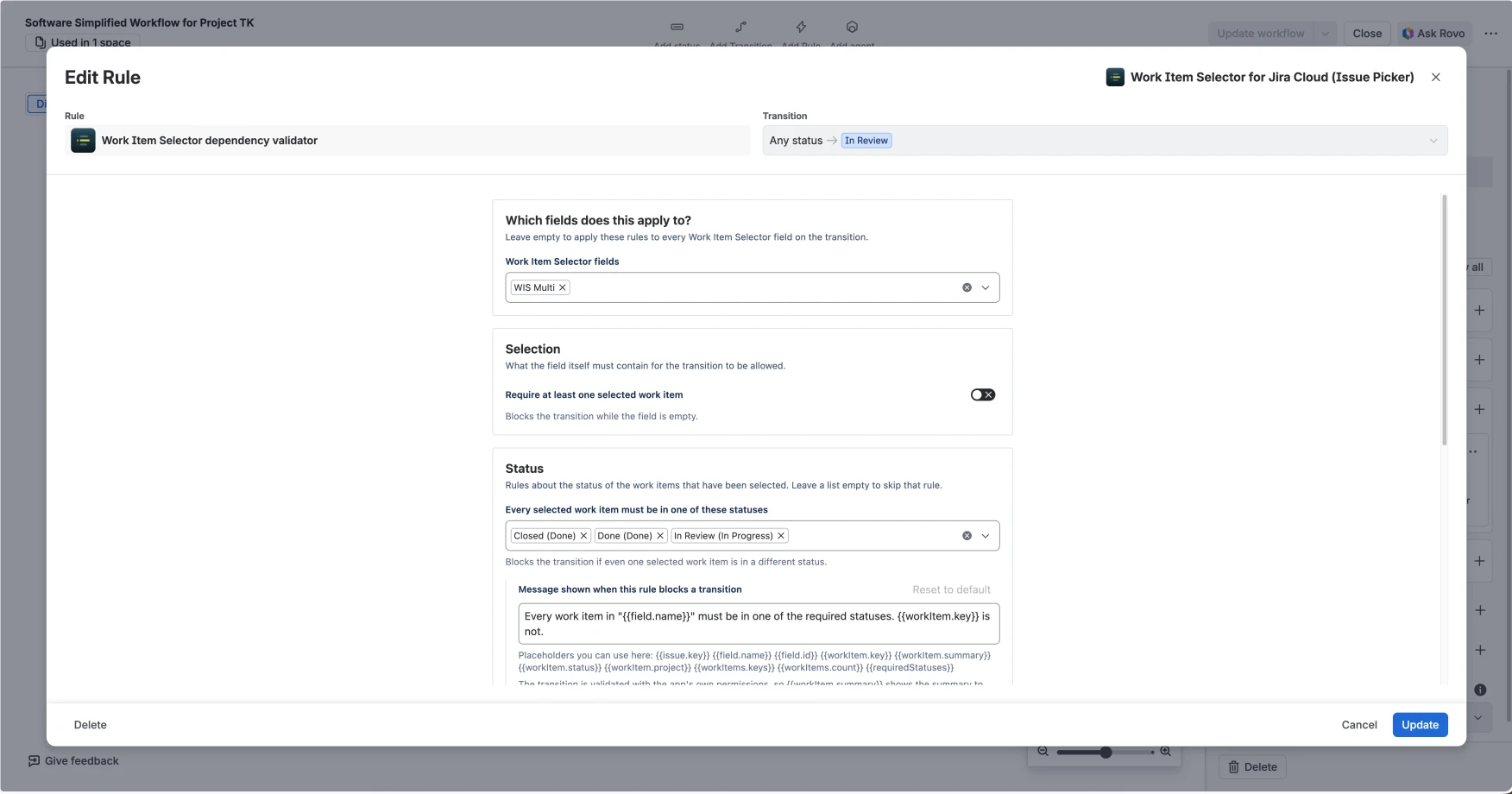
The message a person sees
Each rule has a default message, and an administrator can replace it. The defaults are:
Select at least one work item in "{{field.name}}" before this transition.Every work item in "{{field.name}}" must be in one of the required statuses. {{workItem.key}} is not.At least one work item in "{{field.name}}" must be in one of the required statuses.Work items in "{{field.name}}" must belong to an allowed project. {{workItem.key}} does not.This selection creates a circular dependency back to {{issue.key}}.Tokens are substituted when the rule fires, and unknown tokens are dropped rather than printed. Messages are capped at 500 characters and truncated past that.
If your template renders empty, which happens when it is made only of tokens that are blank
for the rule that fired, {{workItem.key}} on require a selection for instance, the
default is rendered instead. A blocked transition with an empty dialog tells the person
nothing and they cannot fix the configuration that caused it.
What the cycle check does at scale
The circular dependency check fails open
The check runs inside a synchronous transition, so it is bounded by both node count and depth. If the graph exceeds that budget the transition is allowed rather than blocked, and a warning is logged.
Refusing legitimate work is worse than missing a deep loop. If cycle prevention is a hard requirement on a very large graph, this rule is not the control you want.
The configuration screen
The screen reads the field, status and project lists from Jira directly, as the signed-in user, so it shows exactly the fields and projects that person can already see. Each list loads independently: one failing lookup leaves the other rules editable instead of replacing the dialog with an error.
New workflow editor only
Atlassian supports create and edit screens for validators of this kind only in the new workflow editor. This is also the one screen in the application that is not Atlassian UI Kit, because Forge rejects native rendering for validator configuration. Everything a person uses day to day, the picker, the field view and the context configuration, is UI Kit.
Related
- Automation and JQL, which writes and reads the same selections
- Set up the field
- JQL scope
A problem or a question? Write to support@oktul.com or open a request in the Help Center. Both reach the same service desk, so either way the request gets a reference and an SLA measuring the response.